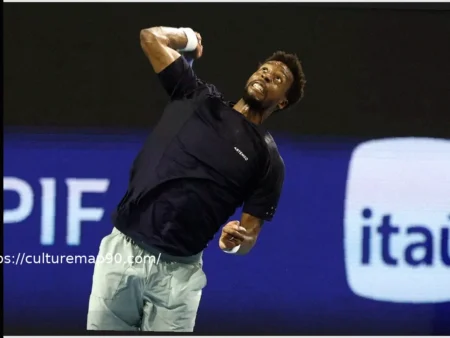

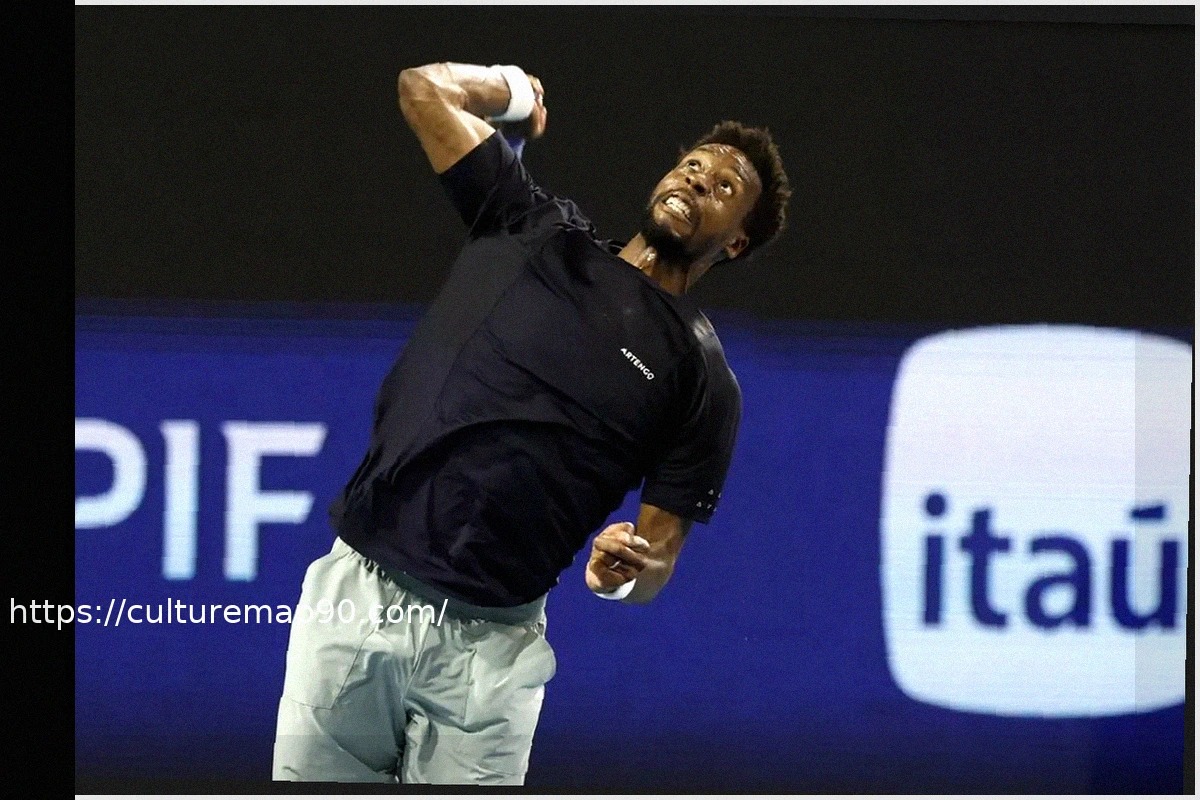
For anyone who anticipated Gael Monfils’ departure from the professional circuit to be a subdued affair – a polite parade of applause, perhaps tearful eulogies from commentators grasping for new words – clearly hasn’t been paying attention. They haven’t been observing this athlete for the past two decades. Monfils simply doesn’t conform to quiet goodbyes. He was never one to meekly accept the conventional dictates of the sport for its veteran players: understand your diminishing role, fall to a much younger opponent, deliver a graceful speech, and fade away.
This past Sunday in Monte-Carlo, entering the tournament as a wildcard and ranked 203rd globally, Monfils rallied from a set down to conquer world number 32 Tallon Griekspoor. This remarkable victory made him the oldest match winner at Monte-Carlo since 1973 and elevated his tally to 145 ATP Masters 1000 match wins, a record for any French player in history. It was an emphatic declaration, reverberating loudly under the Mediterranean sky, perfectly emblematic of how Monfils has always approached everything.
The Myth of the Showman: Obscuring True Competitiveness
Something rather unjust occurred during Gael Monfils’ career trajectory. He became so intrinsically linked with the entertainment aspect of tennis – his acrobatic dives, his audacious between-the-legs shots, his celebratory post-match dances – that a considerable segment of tennis commentary prioritized his showmanship over his actual achievements. He was frequently depicted as an athlete who possessed the potential for greatness but chose instead to merely be spectacular. This was a superficial interpretation of a truly complex career, overlooking the core elements that rendered him genuinely extraordinary.
His accomplishments include reaching two Grand Slam semi-finals: at Roland Garros in 2008 and the US Open in 2016. He contested three Masters 1000 finals, at the Paris Indoors in 2009 and 2010, and at Monte-Carlo in 2016. Monfils also achieved a career-high ranking of world number six. Throughout a professional journey commencing in 2004, he secured 13 tour-level titles, competing for over two decades in an era famously dominated by Federer, Nadal, and Djokovic.
The challenge of forging a distinguished career during the zenith of the ‘Big Three’s’ dominance is widely acknowledged. Yet, Monfils not only endured this period but flourished, consistently reaching the latter stages of major tournaments, and repeatedly recovering from debilitating injuries that would have prematurely concluded lesser careers, always returning to compete.
His flair for the dramatic was never a mere stand-in for his tennis prowess. Instead, it was an outward manifestation of the same athletic brilliance that powered his game. Those breathtaking diving retrieves weren’t mere spectacle; they were the result of a physique moving with a velocity and agility seldom witnessed in the sport, all in pursuit of securing points. His engagement with the crowd wasn’t a diversion from the contest, but rather a vital source of energy.
Monfils himself has characterized the link between his emotional displays and his on-court performance quite simply: it stems from joy, and that joy fuels his creative approach. While athletes who play to the crowd are often accused of not taking the sport seriously enough, for Monfils, the act of performing and the act of competing were always intrinsically linked.
Resilient and Enduring: Still in the Game
In January 2025, Monfils etched his name in history as the oldest player ever to clinch an ATP Tour title, securing his 13th career trophy in Auckland at 38 years and 132 days old, surpassing Roger Federer’s previous record. This singular achievement should have fundamentally altered the narrative surrounding his twilight years on the tour.
Monfils is the last remaining ‘French Musketeer’ still actively competing, having outlasted Tsonga, Gasquet, and Simon, who have all retired. For many years, this generation bore the weight of French tennis, a demanding role evidenced by their complex careers, marked by moments of individual brilliance yet often overshadowed by the question of unfulfilled potential. Monfils carried this burden the longest, and arguably with the greatest ease, seemingly grasping better than his peers that the sport was fundamentally meant to be enjoyed. He played with a palpable joy that, while perhaps not always reflected in his immediate results, is undeniably a cornerstone of his lasting legacy.
Monte-Carlo: The Next Chapter Unfolds
Sunday’s triumph against Griekspoor marked Monfils’ thirteenth appearance at the Monte-Carlo tournament, a venue he has graced since 2005 and where he famously reached the final in 2016. Despite dropping the opening set in a tiebreak, he asserted his dominance in the subsequent two sets, sealing the victory 6-1, 6-4 against an opponent ranked 170 spots higher than him.
His next challenge in the second round is Alexander Bublik, a match-up that feels almost preordained, given Bublik is arguably the contemporary player who most embodies the spirit Monfils represented at his zenith. Two charismatic entertainers, from different eras, converging on the same court. A captivating spectacle is assured, and that statement has never rung truer.
Monfils has declared his intention to approach every match as if it were his last. If his performance on Sunday in Monte-Carlo serves as an indicator, then the ATP tour is poised to witness many more months of a forty-year-old Frenchman vociferously challenging the notion of a ‘graceful decline.’ He clearly believes he has more to offer. He knows it, the Monte-Carlo crowd sensed it, and anyone expecting a subdued farewell tour has fundamentally misunderstood the man.