

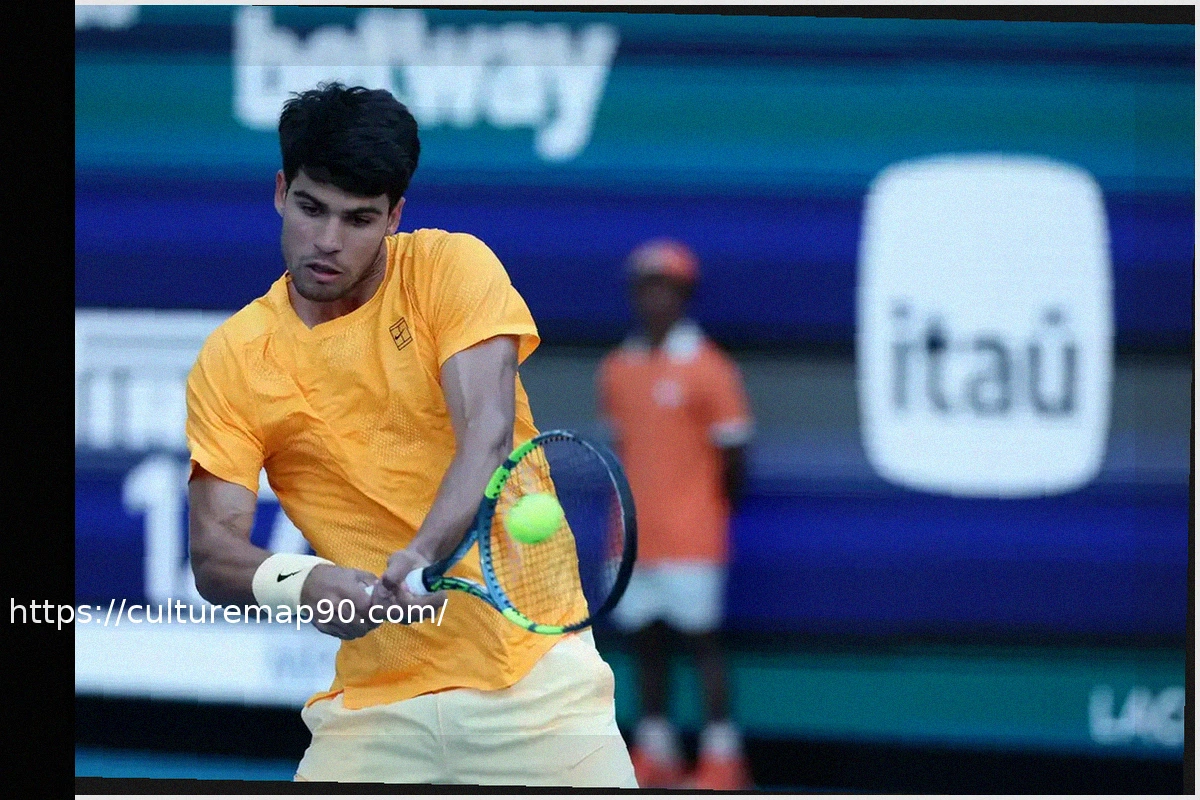
Beginning the year with an impressive 16 consecutive victories, including an Australian Open title, and extending a 34-match winning streak from late 2025, 22-year-old Carlos Alcaraz undeniably continues his trajectory toward tennis greatness. Alcaraz, deeply entrenched in his compelling rivalry with world No. 2 Jannik Sinner—another prodigious talent—usually exudes an intimidating presence on court. However, his performance during the recent ‘Sunshine Double’ tournaments didn’t entirely reflect this dominance.
Defeat by Medvedev in Indian Wells
At the ATP Indian Wells tournament in the Californian desert, Alcaraz faced an early challenge, being pushed to three sets by the lesser-known Arthur Rinderknech. He narrowly escaped that difficult night match after losing the first set tiebreak. Subsequently, he met Daniil Medvedev in the semifinals. Medvedev, in superb form, was nearing a return to the top 10 and had already secured two ATP titles in 2026. He played fearlessly against Alcaraz, utilizing his serve as a potent weapon in the first set. Throughout the match, Medvedev won over 70% of his second-serve points and only faced a single break point.
Even after Alcaraz elevated his game in the second set, breaking to lead 3-1, Medvedev consistently engaged him in grueling, extended rallies, forcing errors. Medvedev immediately broke back, then dominated the tiebreak to clinch a 6-3, 7-6(3) victory. This marked Medvedev’s first win against a world No. 1 since Wimbledon 2024 and ended Alcaraz’s impeccable 16-0 start to the year. The match served as a significant reminder that other players on the ATP Tour, beyond Alcaraz and Sinner, possess the capability to challenge their dominance (Sinner ultimately won the tournament, defeating Medvedev in the final).
Following the match, Alcaraz seemed far from dejected. He commended Medvedev for an “amazing” performance, stating he had “never seen Daniil playing like this.” Alcaraz framed the defeat as a testament to his opponent’s exceptional play rather than a sign of crisis in his own game. Attention then turned to Miami, where the young Spaniard was still widely anticipated to perform dominantly.
Korda Challenges Alcaraz in Miami
Carlos Alcaraz began his Miami campaign against João Fonseca, a promising next-generation player who enjoyed considerable backing from the Brazilian community in Florida. Having only won the Miami title once, in 2022, Alcaraz was highly motivated and demonstrated clear superiority from the outset. He secured a break in each set, fended off all break points on his serve, and maintained a first-serve percentage near 70%, winning approximately 80% of those points. Alcaraz simply overpowered Fonseca in what was an impressive display for both, suggesting a positive trajectory for Carlos in the tournament.
His third-round match brought Sebastian Korda. The American’s talent has always been evident, though he’s often battled with fitness and consistency. Korda, who inherited his tennis lineage from his father, former Australian Open champion Petr Korda, employs a fearless, flat-hitting style that, on his best days, enables him to contend with the sport’s elite.
That ‘best day’ materialized on a Sunday in Miami. Korda delivered an upset, defeating Alcaraz 6-3, 5-7, 6-4, marking the Spaniard’s second loss and earliest exit of 2026. The match lasted just over two hours. Korda’s serve was exceptional in the first set, winning over 80% of his first-serve points, securing a crucial break, and taking it 6-3. In the second set, Korda led 5-4 and served for the match but faltered, getting broken to love. Alcaraz seized the momentum, winning five consecutive games from 3-5 to steal the set 7-5. In the deciding set, Korda broke again for a 4-3 lead with aggressive returns and held his nerve on serve, sealing the 6-4 win with a powerful first serve and a bold forehand on his second match point.
Similar to the Medvedev match, Korda out-served Alcaraz, and his flat, penetrating shots from both wings significantly pressured the Spaniard. This victory marked Korda’s first triumph over a world No. 1.
Beyond ‘Frustration and Disappointment’: Alcaraz’s Current Form
After his Miami defeat, Alcaraz admitted to ‘a little bit of frustration and disappointment.’ He noted numerous ‘very disputed moments’ and missed opportunities, conceding that Korda ‘was better… in those important points.’ Mirroring his reaction after the Medvedev loss, Alcaraz still believed he had played ‘a good match overall.’ He also spoke about accepting that opponents will play with greater freedom against a world No. 1, and his intention to ‘play better in those moments’ going forward.
As the clay-court season approaches, a key question arises: did Alcaraz merely encounter opponents having exceptional, high-serving days, or is he indeed experiencing a dip in momentum, offering other players—beyond Sinner—a clearer strategy to defeat him? Examining his hard-court match record this season reveals that warning signs were present even before these recent losses.
At the Australian Open, Tommy Paul challenged Alcaraz through all three sets but couldn’t secure a single one. In the semifinals, a visibly unwell Alcaraz was put on the defensive by Alexander Zverev, who then suffered a mental collapse, allowing the match to slip away. Novak Djokovic, still formidable but not at his absolute peak, couldn’t maintain a consistently high level in the final. A month later in Qatar, Karen Khachanov claimed the opening set in a tiebreak and forced Alcaraz into a grueling three-setter. Similarly, Rinderknech at Indian Wells led by a set and a break before Alcaraz managed to turn the match around.
Alcaraz isn’t an untouchable player but rather one who has consistently prevailed in closely contested matches, operating within narrow margins. In these encounters, a consistent pattern emerged: opponents were strong servers, flat hitters, players who weren’t intimidated by his return game, and were prepared to hit through his powerful topspin. The recent victories by Medvedev and Korda underscore this point: if you serve effectively enough against Alcaraz, you can indeed emerge victorious.
The Clay-Court Advantage
The tennis calendar now shifts to clay, with tournaments like Monte Carlo, Madrid, and Rome on the horizon. Alcaraz boasts an impressive record on this surface, winning approximately 85% of his tour-level matches—surpassing his hard-court success rate of around 78%. His lifetime clay record stands at 98–18, and he remains undefeated on clay since his loss to Holger Rune in the Barcelona final last April. The big serving and flat hitting strategies effective on hard courts don’t translate as easily to slower clay, which favors heavy spin, agile movement, and meticulous point construction. Consequently, Alcaraz, now benefiting from some unexpected rest, is highly likely to reverse his recent fortunes and embark on another significant winning streak once the tour transitions to clay.
While not unbeatable, Alcaraz is considerably more formidable on clay. This recent period of setback might be precisely the rest and refocusing he needs to perform at his best and continue making history. Meanwhile, the ATP Miami tournament offered an opportunity for another star to emerge, as Alcaraz now prepares to reset and launch his clay-court campaign.