
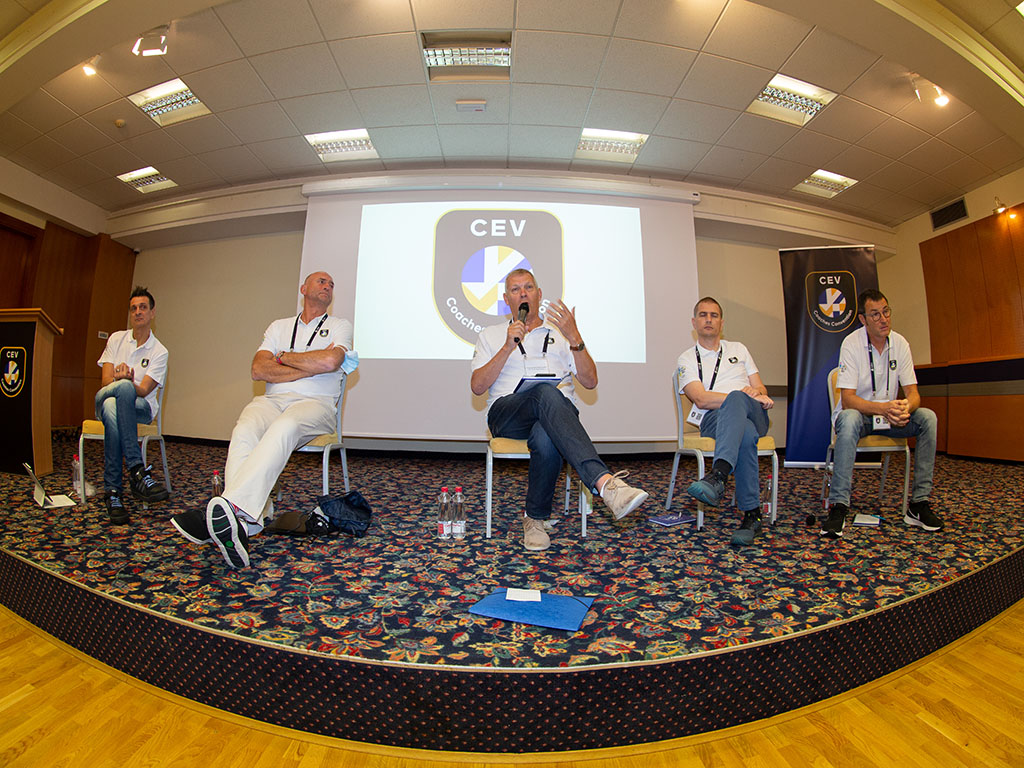
The opening day of the 2025 CEV Coaches Convention in Zadar underscored a commitment not only to volleyball but also to the art of learning itself. The program skillfully blended morning theoretical sessions, exploring key concepts and pedagogical frameworks, with dynamic afternoon practical sessions that brought these ideas to life directly on the court. Three prominent experts – Eric Hodgson, Saskia van Hintum, and Nataliia Klimentova – each offered unique and compelling perspectives, significantly inspiring attending coaches to re-evaluate and enhance their approaches to athlete training and holistic development.

Eric Hodgson: The Coach as a Volleyball Sherpa
Eric Hodgson encouraged coaches to redefine their fundamental role, shifting beyond mere instruction to become “sherpas” who expertly guide athletes through the peaks and valleys of their athletic journey. He vividly illustrated this concept by introducing Mia, a fictional young player navigating the Perception-Action Cycle – a critical framework emphasizing how athletes learn through continuous and integrated interaction between perceiving stimuli, making informed decisions, and executing actions. Hodgson powerfully highlighted the crucial distinction between learning and performance. While performance metrics are captured by the scoreboard, true and lasting learning unfolds in the less visible, often introspective moments: during mistakes, through careful reflections, and via subtle adjustments. For Hodgson, a coach`s primary objective isn`t the pursuit of immediate results, but rather the creation of rich, engaging environments where genuine, deep learning can unequivocally thrive. This necessitates designing game-like training sessions where players are constantly challenged to solve complex problems under conditions that meticulously mimic real match situations. Instead of simply providing all the answers, coaches should actively foster athletes` inherent problem-solving skills, thereby cultivating greater adaptability and robust independence on the court.
Nataliia Klimentova: Cultivating Decision-Making, Resilience, and Growth
Nataliia Klimentova centered her compelling presentation on “The Learning Paradigm,” advocating for a significant shift from traditional, often rigid, skill-drill models towards a more expansive approach that profoundly prioritizes holistic growth, emotional resilience, and individual personal development. She eloquently explained how personality insights, such as those derived from DISC assessments, can deeply enhance a coach`s understanding of their athletes, thereby enabling more effective connection, clearer communication, and more powerful inspiration. By acknowledging and appreciating diverse personality types, coaches can significantly enhance their tactical acumen and emotional intelligence, empowering athletes to flourish both as unique individuals and as integral parts of a cohesive team. Klimentova also urged coaches to fundamentally reframe the very essence of volleyball training itself. Beyond mere technical execution, training should be conceptualized as a vital space where athletes learn to take full ownership of their decisions, bravely embrace resilience in the face of setbacks, and diligently cultivate a growth mindset. For her, volleyball transcends mere performance under pressure; it is, at its core, a powerful vehicle for empowerment.
Saskia van Hintum: Setting the Standard for Setters
Saskia van Hintum expertly directed attention to one of volleyball`s most consistently debated and widely admired positions: the setter. She posed a fundamental and thought-provoking question: “How do we create a setter?” According to van Hintum, setting is arguably the most challenging and intricate technique in volleyball, demanding a sophisticated blend of technical precision, acute tactical intelligence, and profound emotional maturity. A setter, she argued, isn`t simply born into the position but is meticulously developed through the dedicated cultivation of keen vision, impeccable timing, and, above all, exemplary leadership. Her insightful discussion prompted coaches to deeply consider: When does someone truly transcend into becoming a setter? Is it upon the mastery of the physical technique, or when they confidently and strategically orchestrate the entire game? In van Hintum’s insightful view, it is demonstrably both – a refined technical craft interwoven with a strategic art that absolutely requires patient nurturing and the consistent upholding of exceptionally high standards.
Conclusion
Day 1 concluded with coaches feeling profoundly inspired to look beyond superficial drills and immediate outcomes, embracing coaching as a transformative pathway for continuous learning, personal growth, and comprehensive athlete empowerment. The Convention is set to continue on Sunday with engaging creative workshops, offering participants invaluable opportunities to explore innovative methodologies, collaboratively exchange rich experiences, and apply newly acquired ideas into practical, real-world coaching scenarios within a highly collaborative setting.