
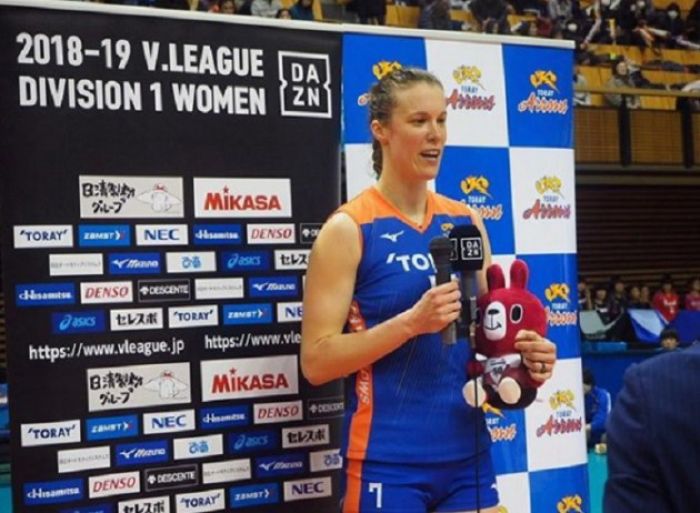
Jana Kulan, a former elite volleyball player who competed in as many as ten different countries across the globe, has embraced coaching with a clear and ambitious mission: to inspire others to enjoy volleyball in an environment where fun is paramount. She is currently navigating the inherent challenges of coaching, and while not every moment is easy, she finds the journey deeply fulfilling and rewarding.

An Unexpected Path to Coaching
Earlier this year, Kulan, a former star player for the national teams of her native Slovakia and adoptive Azerbaijan, also became a member of the European Coaches Commission. Her venture into coaching began almost by chance. During a particularly challenging period in her private life, she discovered that volleyball could offer the best way to regain control, even if no longer exclusively as an elite player. “I was fortunate enough to enroll in a FIVB Coaching Course Level 1 held in Estonia. The instructor there was John Kessel, and the experience literally changed the course of my life,” she recounts. “I am lucky to call him my friend and my mentor. His words and teaching made me understand that volleyball could still play a pivotal role in my life, even though I would look at it from a very different perspective than before.”
The Shift from Player to Mentor
Transitioning from an elite athlete to a coach is far from simple. “You need to change your approach completely. As a player, you often feel like life revolves around you, being served by many people. As a coach, however, you are primarily there to serve others,” Jana explains. “You should be the first person to get to a session – the players need to see you right away when they arrive at the sports hall. You are the one setting the tone. It is a completely different ball game.”
Kulan also attributes much credit to her husband, who has been by her side since 2014. “We have been coaching together, and we complement each other very well. He is extremely good at challenging me – I can focus on tactics and technique, whereas he is good at managing people, building a team, and streamlining communication.” Jana recognizes that as a coach, it is crucial to think outside the box, as no single approach works identically everywhere, and there is no one-size-fits-all solution.

Navigating Modern Challenges in Youth Coaching
She is aware that coaching youngsters can be challenging at times. “As a former elite athlete, you possess a highly competitive spirit, a fire within yourself, which is not always shared or even understood by the players you work with. I worked with girls in Czechia for whom volleyball was more of an opportunity to spend time with their friends rather than to strive for success and higher echelons.” However, she notes that today’s youngsters also face a very different social environment than previous generations. Social media often emphasizes perfection and ideal role models that can seem unattainable for many. Moreover, youngsters frequently struggle to deal with failure. “Yet it is precisely in learning to deal with setbacks and becoming stronger through them that sport – and volleyball in particular – can help us shape mature, responsible, and well-rounded people,” she emphasizes.
Spreading the Joy of Volleyball
After John Kessel`s influence paved the way for her coaching transition, Jana is now committed to igniting the same passion in others. Most recently, she delivered clinics in India, where she observed the profound hunger for knowledge among local PE teachers and coaches. “Such experiences are extremely rewarding, especially as I am incredibly eager to pass on my knowledge and experience to the best of my ability. I was truly pleased when people approached me and said that, for the first time in 20 years, they had not only learned but also genuinely enjoyed themselves while playing volleyball.”
Volleyball faces tough competition from other sports to attract and retain youngsters, but Jana identifies fun as the crucial element. “Too often, coaches spend weeks or even months on overhead passing and other technical skills, where ball control is tough for beginners, and the fun is minimal. I believe we should flip this approach: let kids start with spiking – smashing the ball – so they can experience the excitement and reward of the game from their very first days, instead of waiting until after they have mastered the less engaging basics. The more fun there is, the more likely they are to return and to stick with the sport,” she stresses. “Moreover, volleyball is truly a sport for everyone, regardless of technical and physical abilities. People in India were wondering how they could be good at playing the game when they are fairly short in stature. I told them to look at Japan – whose players are fairly short compared to other countries, and yet they are among the top five teams in the world. We should look for solutions rather than for excuses. I also see much room for engagement with Sitting Volleyball. I have learned that in the Netherlands there are some 4,000 people playing the game, of which 3,500 have no disability. There you clearly see that volleyball is truly a sport for everyone – not only for the tall or the powerful ones!”

Breaking Barriers as a Female Coach
As a female coach, Jana has also had to overcome other challenges. “Strangely enough, while coaching in Türkiye, I had the feeling that the male coach standing on the other side of the net saw in me an extra motivation – as if the two of us were battling, and not our teams – with an attitude of, ‘I cannot lose to a team coached by a woman!’” The sight of a female coach remains quite uncommon, and therefore she welcomes the decision made by FIVB to have at least one female member of a team’s coaching staff. “If females become more visible, others will realize that they can do the same. We need role models to look up to, trailblazers showing the way so that others can follow in their footsteps. As soon as there is a level playing field, quotas will hopefully become redundant, and coaches – male or female – will be judged solely on merit,” she continues.
A Global Perspective on Leadership
Jana conveys the impression of someone who has managed to find the right balance between self-belief and humility, while still ready to challenge herself. She takes many valuable lessons from the countries where she has played and coached – while being aware that models cannot be easily replicated. “Japan was for me a standout experience, since everything is so well-organized, players are incredibly disciplined, and respectful. In Vietnam, where I combined the roles of coach and player, I somehow rediscovered for myself how much fun volleyball can be. All these experiences have forged me and made me the person I am today,” she says.
Finally, Kulan summarizes her approach with a few wise, poignant words: “I believe that while we cannot control everything, we can influence a great deal. True leadership, especially in coaching, is not about always having the answers or doing all the talking. It is about knowing when to step back, creating space for others to speak and act, and being open to multiple perspectives. By challenging yourself, listening deeply, and surrounding yourself with people who help you grow, you not only become a better person but also a better coach. Even though competitive sport is mostly about success, there is a place for everyone to feel welcome and to fit in.” Her second life in volleyball has literally just begun.