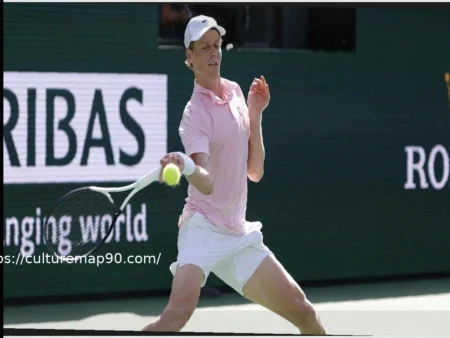

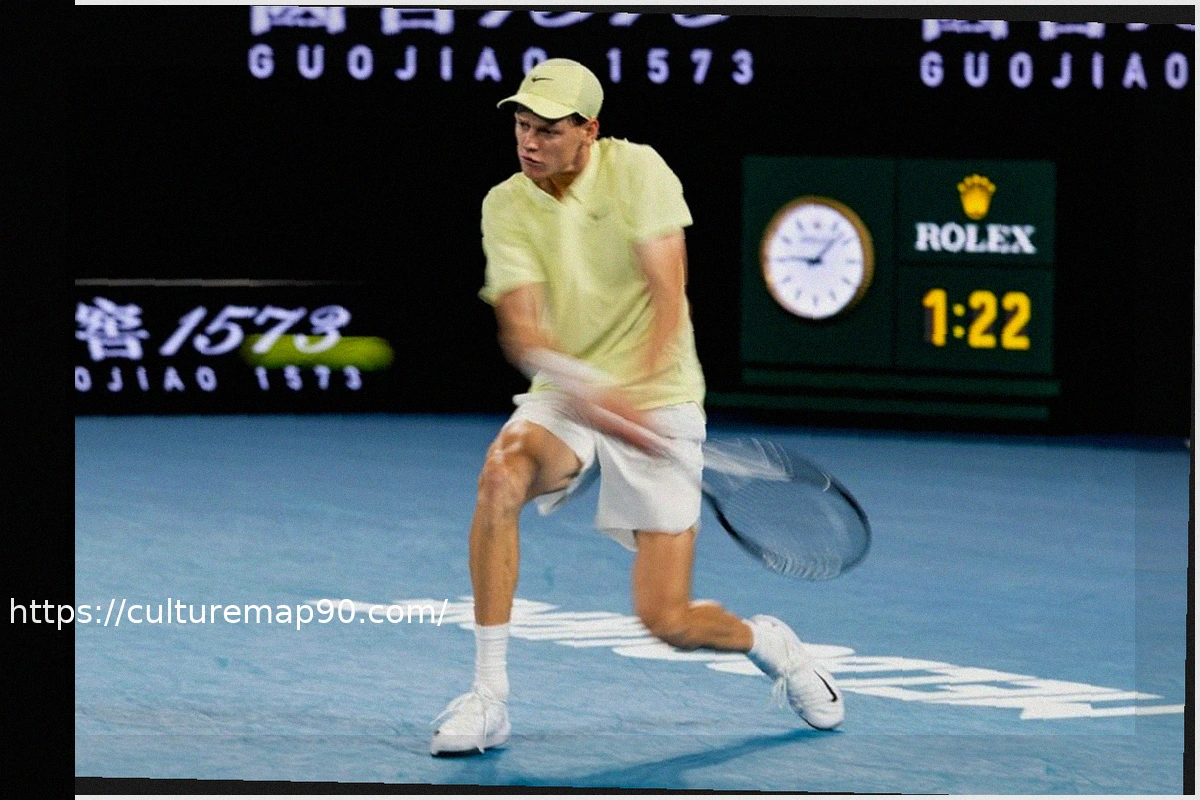
On Sunday, Jannik Sinner claimed the BNP Paribas Open title, defeating Daniil Medvedev with a score of 7-6, 7-6 in a final many expected to be evenly matched. Medvedev arrived at the final in peak form, having just decisively beaten Carlos Alcaraz in the semifinals, halting Alcaraz’s 16-0 streak in 2026. His aggressive, forward-moving baseline play even prompted Jim Courier to describe it as the finest he had witnessed from the Russian. Medvedev appeared to be prepared, motivated, and in excellent condition.
Despite this, Medvedev failed to break Sinner’s serve even once throughout the two sets and two tiebreaks; he didn’t even generate a single break point opportunity. This outcome wasn’t due to baseline strategies, court positioning, or tactical shifts. Instead, it was Sinner’s first serve performing at an extraordinary level, a standard rarely seen, especially from a 24-year-old baseliner from Sexten.
The performance witnessed at this tournament was truly remarkable and warrants thorough analysis.
Unprecedented Statistical Anomalies
Sinner’s unreturned first serve rate during the two-week event was approximately 53%. His serve rating for the tournament reached an impressive 8.7, a metric typically associated with the sport’s most legendary servers. Throughout the competition, he surpassed his personal 52-week average for unreturned serves by 11%, secured 6% more points on serve than his usual, and improved his serve placement by a notable seven centimeters. These figures are not minor discrepancies or typical statistical variations; they indicate a player who arrived at the event with a dramatically enhanced, almost revolutionary, serving weapon.
The significance of that 53% unreturned first serve rate becomes clearer with proper context; without it, the number seems impressive but abstract. With context, however, it borders on the improbable.
For comparison, John Isner, widely regarded as one of the Open Era’s most formidable servers, holds a career average of 54.0%. Pete Sampras, often considered the benchmark, who dominated Wimbledon for seven straight years, boasts 53.3%. Milos Raonic, whose powerful serve propelled him to a Wimbledon final, stands at 52.9%. Giovanni Mpetshi Perricard, a rising talent known for his massive serve, records 52.3%, and Nick Kyrgios registers 51.1%.
For the duration of this single tournament, Sinner achieved serving statistics that placed him squarely within this elite group, not merely approaching their level, but matching it directly.
To grasp the sheer improbability of this achievement, one must consider the typical serving percentages of elite all-around players who aren’t primarily serve specialists. Roger Federer, renowned for one of the most tactically astute serves in tennis history, holds a career average of 41.5%. This observation is not a critique of Federer, but rather an illustration of the reality that a player whose game prioritizes comprehensive tennis over overwhelming serving power will typically achieve world-class figures in that range. Sinner’s serving at Indian Wells transcended comparison with Federer’s; it was fundamentally distinct, aligning more closely with the power-serving dominance of players like Isner, especially on a hard court.
The Medvedev Predicament
This leads us to arguably the most telling statistic from the entire tournament.
In the final, Medvedev managed to win only four out of 47 points against Sinner’s first serve, resulting in an astonishing 91% win rate for the Italian on his initial delivery. It’s crucial to acknowledge that Medvedev is among the tour’s top returners, his strategy built upon neutralizing powerful serves and systematically overwhelming opponents from the baseline. Facing Sinner, he retreated deep, attempting to absorb the incoming pace and locate non-existent angles or openings. Sinner’s precision serving consistently denied the Russian any significant opportunity to establish a return game. The critical entry point for Medvedev’s strategic approach was effectively sealed, bolted, and fortified.
What makes this situation particularly telling is that Medvedev himself did not perform poorly; this is the core insight. He essentially replicated the aggressive, early-ball, high-tempo tennis he displayed against Alcaraz the previous day. Both finalists secured impressive percentages of points on their first serves (77% for Medvedev and 90% for Sinner, respectively), and neither player faced a break point throughout the match. The differences were minimal across most aspects of play, with one critical exception: Medvedev was rendered a mere observer on return.
In his semifinal against Alcaraz, Medvedev’s return game was a tangible factor. Alcaraz, whose serve isn’t typically categorized among the sport’s most dominant, relies on exceptional movement, shot-making prowess, improvisation, and athletic creativity to win matches. Against Sinner, however, the unearned points that Alcaraz rarely secures were consistently claimed by Sinner. These effortless points effectively depleted Medvedev’s return game from start to finish. Although Medvedev frequently won the longer rallies, he ultimately lost the match because an overwhelming number of points concluded before any rally could truly develop.
An Unprecedented Challenge
Sinner’s victory made him only the third man ever to complete the full collection of six ATP Masters 1000 hard court titles, placing him alongside legends Novak Djokovic and Roger Federer in an elite group. Furthermore, he achieved another historic feat by becoming the first man to win consecutive Masters 1000 titles without conceding a single set. These are the remarkable statistics that will undoubtedly feature prominently in future record books and sports broadcasts.
However, the underlying narrative presents a far more concerning reality for the rest of the professional tour.
Jannik Sinner is unquestionably one of the world’s top players, and he doesn’t typically require a historically dominant serve to secure wins. He regularly triumphs through his robust baseline game, a common hallmark of champions. Yet, when his serve reaches the extraordinary level seen at Indian Wells—transforming from a dependable asset into a statistical outlier that rivals the likes of Isner and Sampras for two weeks—he becomes virtually unbeatable on hard courts. Truly unplayable.
This defines the “Sinner servebot problem”—a formidable challenge without an apparent solution. The concern isn’t that he will maintain this extreme serving level consistently; the sample size is too limited and the performance too exceptional to set such an expectation. The critical point is his capability: he possesses the refined mechanics, mental fortitude, and precise placement to deliver such a serving display in crucial moments, against elite returners, on the sport’s grandest stages. When he achieves this, no current professional tennis player has yet found a consistent counter-strategy.
The rest of the ATP Tour must now contend with a World No. 2 player who not only can dominate from the baseline but also, in any given tournament, possesses the ability to serve them off the court before baseline exchanges even come into play. This isn’t merely a tactical dilemma; it’s a profound challenge embodied by one name: Jannik Sinner.