
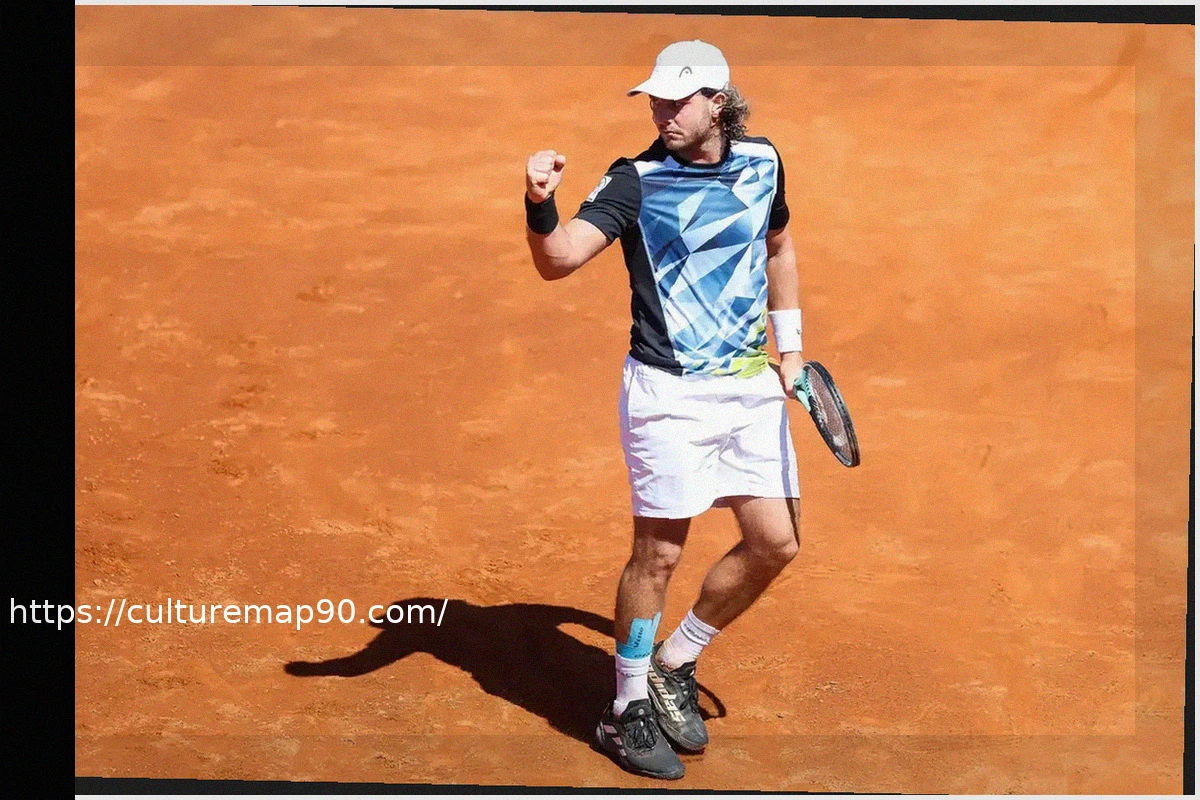
For nearly two decades, Marco Trungelliti navigated the world of professional tennis largely unnoticed. He possessed enough talent to persevere but struggled to reach the sport’s pinnacle. Now, at 36, he has finally broken through. His remarkable odyssey illuminates what tennis cherishes and what it often overlooks.
The Inspiring Narrative of Marco Trungelliti
Marrakech, April Fool’s Day, 2026
In a moment of poetic irony, on April 1, 2026, in Marrakech, Morocco, 36-year-old Argentine Marco Trungelliti secured a 7-6, 6-3 victory over Polish qualifier Kamil Majchrzak. This win propelled him into the ATP Top 100, marking him as the oldest player in half a century to achieve this feat. The timing, on April Fool’s Day, made his arrival almost impossibly perfect.
His path to this milestone, punctuated by arduous road trips, battles against corruption, chilling death threats, periods of deep depression, and self-imposed exile, stands as one of modern sport’s most compelling narratives. It also serves as a profound reflection on tennis itself: its inherent harshness and moments of splendor, its flawed financial ecosystem, and its undeniable allure. The sport’s tendency to consume countless aspiring athletes, discarding most while elevating a select few to global acclaim, is starkly illustrated through his journey.
Trungelliti was never among that privileged elite. And it is precisely this distinction that renders his accomplishment so extraordinary.
From Obscurity to Aspirations
Born on January 31, 1990, in Santiago del Estero, a secluded and economically disadvantaged region of Argentina, Marco Trungelliti’s tennis journey began watching his parents at a local club. By age five, he was playing; by fourteen, he had left his family, hometown, and all familiarity, relocating first to Chaco and then Buenos Aires to dedicate himself fully to the sport. In a world where many young talents emerge from affluent academies in places like Florida and Spain, supported by private coaches, managers, and substantial sponsorships, Trungelliti was, in his own words, ‘the kid from the middle of nowhere.’ He packed his bags before his teenage years, convinced that tennis was his sole path forward.
Turning professional in 2008, Trungelliti spent his initial years predominantly within South America. This represented the unseen stratum of professional tennis: a realm where thousands of athletes toiled through ITF Futures tournaments across Latin America, often earning just enough to cover essential travel and lodging, accumulating ranking points incrementally. Trungelliti endured this unglamorous, untelivised existence for years. Lacking media attention or profiles, he simply persisted.
Mastering the Qualifier’s Path
By 2012, Trungelliti had fought his way onto the ATP Challenger Tour, the sport’s secondary circuit, making his first ATP main-draw debut at the Croatian Open. For the subsequent decade, the Challenger circuit became his familiar terrain: red clay courts in European provincial towns, often with sparse crowds. He claimed sixteen titles at Challenger and ITF levels, with all but one on clay, boasting a career win rate exceeding 62% on the surface. Statistically, he established himself as one of the most consistent clay-court performers outside the sport’s elite.
However, for much of his career, Trungelliti was defined not by his titles, but by his ranking: world No. 112, attained on March 4, 2019. This had long been his seemingly insurmountable peak. Despite a highly productive 2025, where he secured three Challenger titles, reached four additional semifinals, and achieved 51 wins (his second-highest annual tally and most since 2018), the coveted top-100 threshold remained stubbornly, almost cruelly, out of reach.
His ATP Tour main-draw record is notably sparse, with fewer than twenty wins throughout his career at this elite level. This statistic, however, is deceptive, as Trungelliti consistently had to navigate qualifying rounds for virtually every top-tier tournament he entered. Unlike some, he received no wildcards in Argentina, nor was he ever given an easy entry. Each time he reached a main draw, it was only after triumphing in three prior qualification matches.
The Unforgettable Road Trip to Paris
One particular story, though its protagonist’s name might fade, remains etched in the memory of tennis enthusiasts.
In May 2018, Trungelliti was eliminated in the final round of French Open qualifying on a Thursday. He returned to his home in Barcelona, where he had planned a vacation with his family, including his mother, brother, and his 88-year-old grandmother, visiting from Argentina.
Suddenly, his coach called with news: Nick Kyrgios had withdrawn, opening an eighth lucky loser slot, and Trungelliti was next in line. With his grandmother in the shower, he excitedly knocked on the bathroom door to inform her they were heading to Paris.
Moments later, the entire family of four was in the car, ready for the journey.
The grueling ten-hour drive covered 1,000 kilometers, bringing them to Paris just before midnight. With his match scheduled for the next morning, Trungelliti managed only five hours of sleep before stepping onto the court. He then proceeded to defeat Bernard Tomic in four sets, securing £69,000 in prize money—more than double his entire earnings on tour for that year. Following his victory, he was ushered into the main press conference room at Roland Garros, an unprecedented experience for him, even after a significant win against a top-ten player two years prior.
After the match, he shared a beer with his grandmother, a moment captured in a photograph that quickly went viral globally. The image showed his grandmother, radiant in the stands—a woman who, as Trungelliti recounted, had little grasp of tennis scoring but instinctively knew something truly special had occurred.
She passed away in 2024 at 94. Trungelliti often speaks of that Paris trip as a memory he will cherish forever.
A Defining Choice: Integrity Above All
Yet, preceding the celebrated road trip, the iconic photograph, and the worldwide admiration, lay a much darker chapter. This was a story Trungelliti tirelessly sought to reveal, while the tennis community, for years, seemed intent on ignoring it.
In 2015, a mutual contact arranged a meeting for Trungelliti, presented as a potential sponsorship discussion. There, two men candidly detailed an extensive match-fixing operation within Argentine tennis. They spoke of cash payments in briefcases and envelopes, implicating eight specific players. They offered rates: a few thousand dollars for a Futures match, approximately $20,000 for a Challenger, and up to $100,000 for an ATP-level event. Their intention was to recruit him into the scheme.
Trungelliti refused. Subsequently, he took a step that would ultimately prove far more costly than he could have imagined: he reported the entire incident to the Tennis Integrity Unit (TIU).
The ensuing investigation, which wrapped up in 2017 and necessitated Trungelliti’s testimony via video call from Barcelona, resulted in bans for three Argentine players. Nicolas Kicker, once ranked as high as world No. 78, received a six-year ban; Patricio Heras was suspended for five years; and Federico Coria faced a two-month suspension. These individuals were not minor figures; Kicker, notably, was a legitimate top-100 talent.
During the hearing, both Trungelliti and the accused players could see each other on screen. He later recalled feeling utterly unprepared for the emotional weight of that confrontation.
For Trungelliti, a crucial distinction exists: he did not actively seek out corruption. Instead, corruption approached him, attempted to draw him in, and he decisively rejected it, choosing instead to report it. By any reasonable measure, this exemplifies the conduct expected of an athlete with true integrity.
However, the wider tennis community did not initially perceive his actions in the same light.
The Sport’s Betrayal of its Whistleblower
The repercussions for upholding his integrity were severe. Trungelliti endured death threats aimed at him and his family, saw his social media accounts compromised, and was publicly branded a ‘snitch’ during a 2016 Davis Cup tie. He faced ostracism from segments of the Argentine tennis community. In his subsequent tournament in Buenos Aires, despite being seeded and the highest-ranked Argentine, he lost in the first round of qualifying amidst an atmosphere he described as unprecedentedly hostile.
Official support proved almost negligible. The Tennis Integrity Unit eventually released a statement on his behalf, but only three months after the investigation was made public—not within days or weeks, but months. During this critical period, Trungelliti remained exposed and largely isolated.
In response, he and his wife relocated from Barcelona to Andorra, reluctant to ever return to Argentina.
The delayed vindication only intensified his bitterness. Once Trungelliti fully shared his story publicly, other players began to corroborate the prevalence of corruption. Novak Djokovic, for instance, admitted he was offered $200,000 to intentionally lose a first-round match early in his career. Even Sergiy Stakhovsky, who had initially disparaged Trungelliti, later confessed to being approached himself. Trungelliti reflected that while the truth ultimately surfaced, its delayed arrival and immense personal cost had fractured something within him, rather than healing it.
He commended Novak Djokovic and Vasek Pospisil for establishing the Professional Tennis Players Association (PTPA), an organization whose meetings he regularly attended. His criticism, however, was sharper for others: he noted that players who stayed silent on corruption, even while maintaining active public presences through interviews and social media, had inadvertently fostered the very culture he had strived to challenge and change.
The Economic Realities of Unseen Players
The match-fixing scandal, as Trungelliti consistently emphasized, did not materialize in isolation. He understood deeply that the underlying structural economic conditions which render match-fixing so alluring are not mere footnotes; they are fundamental to the narrative itself.
Tennis operates under a highly concentrated economic model where prize money predominantly funnels to the elite. An athlete like Trungelliti, who dedicated almost two decades to professional play and accumulated roughly $1.5 million in career earnings over that period, still remains far from the financial stability enjoyed by a mid-ranked ATP Tour player. His £69,000 prize from the 2018 Roland Garros first round, for instance, represented more than double his earnings for the entire season up to that point. This isn’t an isolated incident; it’s an inherent systemic issue.
Trungelliti has candidly critiqued the system, labeling it a ‘disaster’ and challenging the common misconception that players outside the top 100 are inherently inferior and should be content with meager rewards. He views this dismissive attitude as a form of psychological neglect, a perspective difficult to dispute. When bookmakers offer a Challenger player three or four times their typical weekly prize money to fix a single set, the temptation becomes painfully clear. Trungelliti, however, stood firm. He also highlighted that most players in his situation aren’t even approached for match-fixing; they are simply left to struggle in obscurity.
The Darkest Period and the Resilient Return
By 2020, Trungelliti was on the brink of quitting. He has openly shared the immense mental toll of that era, recounting telling his wife he could no longer endure it and attending training sessions purely out of routine rather than conviction. He was prepared to leave the sport behind.
Yet, he persevered. The birth of his son, Mauna, with his wife Nadir Ortolani in Andorra, nestled amidst the Pyrenees’ forests and rivers, marked a turning point. Trungelliti often credits fatherhood with reshuffling his priorities and instilling a long-absent serenity in his game. He has also spoken about the profound depression that followed the match-fixing scandal, enduring for several years, and the significant psychological effort he invested to release the anger and resentment he carried.
In 2023, he fulfilled his mother Susana’s lifelong dream of visiting Africa by taking her to the inaugural Rwanda Challenger in Kigali. He went on to win the tournament, with her proudly watching courtside. The subsequent photograph of them together subtly mirrored an earlier image from years past—a different woman in the stands in Paris. This reveals a consistent theme in Trungelliti’s career: he consistently performs at his peak when surrounded by the presence of his loved ones.
By 2025, he had claimed three more Challenger titles. Entering 2026 with a career-best ranking, his semifinal performance in Marrakech culminated, on April 1st, in the long-awaited milestone that had eluded him for nearly two decades.
The Essence of Tennis: Realities and Aspirations
The perceived beauty of tennis is often depicted through iconic images: Roger Federer gracefully at the net, Rafael Nadal fiercely battling on the clay of Roland Garros, or Carlos Alcaraz athletically leaping for a drop shot. While these portrayals are accurate, they offer only a partial view.
True beauty in tennis also lies with the qualifier who drives through the night, driven by a profound love for the game that surpasses the desire to simply go home. It resides in the provincial player who courageously reports a match-fixing offer to authorities, enduring three years of threats and ostracism for their integrity. It embodies the 36-year-old tireless competitor from Santiago del Estero, often ranked below 200, whose career-best was 112 before this week, yet consistently appears, season after season, on obscure clay courts in towns far from the spotlight.
Trungelliti, known by the nickname ‘Cafe,’ supposedly due to his darker complexion and composed demeanor, found his idol in David Ferrer. This choice of hero speaks volumes about the player he aspired to be: perhaps not the most naturally gifted or explosive, but undeniably the most relentless. A competitor who could be defeated, but never truly broken.
He admits he came close to breaking. The fallout from the match-fixing scandal, the systemic apathy, and the isolation in a small principality far from his roots pushed him to the edge. Yet, what sustained him, he explains, was something more fundamental than mere ambition: his profound love for tennis. He cherishes the travel, the clay courts, the post-match asado after a demanding week on the road, and the joy of taking his mother to Africa to win a tournament in her presence.
From his nocturnal drive to Paris to discovering new horizons in Kigali, Trungelliti has consistently embraced tennis on his own terms. Family, curiosity, and unwavering integrity have been constant companions on his journey. This narrative provides the perfect lens, reflecting what sport, at its purest, truly ought to represent.