
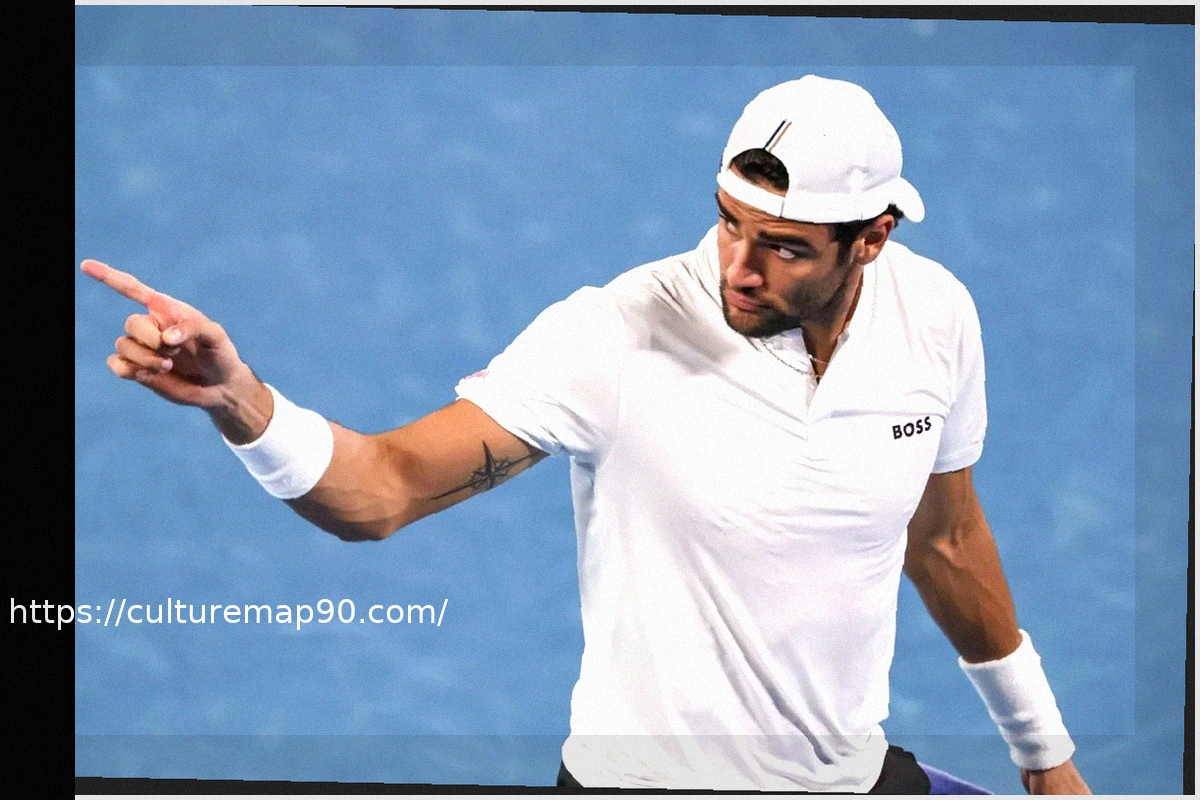
Matteo Berrettini! Once, this name was a symbol of Italian tennis excellence and its promising future.
Not so long ago, the powerful Berrettini was the face of Italian tennis; today, he often feels like an afterthought in discussions. There’s a stark irony in his current struggle for relevance while his compatriot, Jannik Sinner, contends for the world No. 1 ranking. This stark contrast underscores the rapid shifts in tennis fortunes, where today’s star can quickly become yesterday’s headline.
Berrettini’s Decline
His past achievements reveal the extent of his departure from his former stature as Italian tennis’s leading figure. He holds the distinction of being the first male player born in the 1990s and the first Italian man to reach at least the quarterfinals at all four Grand Slams. He contributed to Italy’s Davis Cup victories in 2024 and 2025, maintaining an undefeated record in his matches. In 2021, he made history as the first Italian (male or female) to reach the Wimbledon singles final. By all accounts, he was destined to guide Italian tennis to unprecedented heights.
Currently ranked No. 90 on the ATP Tour, he now finds himself overlooked, trailing not only Sinner but also rising talents like Lorenzo Musetti, Flavio Cobolli, and Luciano Darderi. Consequently, he rarely receives a seeding in the recent tournaments he’s entered.
His dramatic decline isn’t solely attributable to a drop in skill. Maintaining physical fitness has been an immense challenge for him. Persistent injury struggles have not only limited his playing time but also significantly impacted his mental well-being.
In January, he candidly discussed these effects, stating, “Mental health has emerged as one of my top priorities. While I diligently manage my nutrition, training, sleep routine, and other aspects, mental well-being has become pivotal, particularly because of the injuries and their associated consequences.” This isn’t the first instance he has alluded to mental health concerns, indicating its significant role in his recent difficulties.
Monte Carlo Preview: Medvedev vs. Berrettini
A New Beginning
After a disappointing start to his 2026 season and facing the prospect of missing the French Open main draw, he recently added Thomas Enqvist to his coaching team. This week, he commented, “With him and Alessandro Bega, I believe I’ve assembled the ideal team to support me on the journey I’ve outlined for myself.” He now aims to convert this strategic shift into tangible on-court victories, hoping the clay-court season ushers in a positive change in his career.
His second match in Monte Carlo pits him against Daniil Medvedev. He had a relatively easy first round, as his opponent, Roberto Bautista Agut, retired due to injury after just four games, requiring minimal effort from Berrettini.
This sets up an intriguing encounter against the Russian. Despite not being at his peak form, Berrettini is undeniably the more proficient clay-court player of the two. Nevertheless, he has never defeated Medvedev in their three prior encounters, though all those matches took place on hard courts, widely considered Medvedev’s strongest surface.
Berrettini could find inspiration in his opponent, Medvedev, who spent much of the previous year struggling but has since regained his momentum, securing two titles this season and re-entering the ATP top-10. A victory against such a formidable opponent would undoubtedly provide the Italian with a crucial confidence boost and reinforce his belief that he can still compete at the highest level of the tour.
The Urgency of Time
The dynamics of the match itself are somewhat foreseeable.
Berrettini will likely aim for quick, decisive points, leveraging his powerful serve and forehand to dictate play. Conversely, Medvedev will almost certainly seek to prolong rallies, hoping to exploit Berrettini’s backhand, which, despite recent adjustments, remains a relative vulnerability. Regardless, the match promises to be captivating, largely due to this distinct contrast in playing styles.
Berrettini’s brief first-round match offered little insight into his current adaptability to clay-court tennis. The crucial question revolves around his physical endurance: can his body withstand the demanding rigors of clay against Medvedev, especially on Monte Carlo’s famously slow courts?
At 29, and soon to turn 30 before the tournament concludes, the former icon of Italian tennis faces a critical juncture. He must desperately hope for a swift turnaround in his career as he approaches what are likely his final years in professional tennis.
He is undoubtedly hoping for a fresh start, to finally fulfill his early potential. Otherwise, his career’s conclusion will inevitably be marked by the poignant question of ‘what if.’ The upcoming match against Medvedev presents a potentially career-defining opportunity for the Italian, who once pioneered so much for his country’s tennis. Only time will reveal the outcome.