

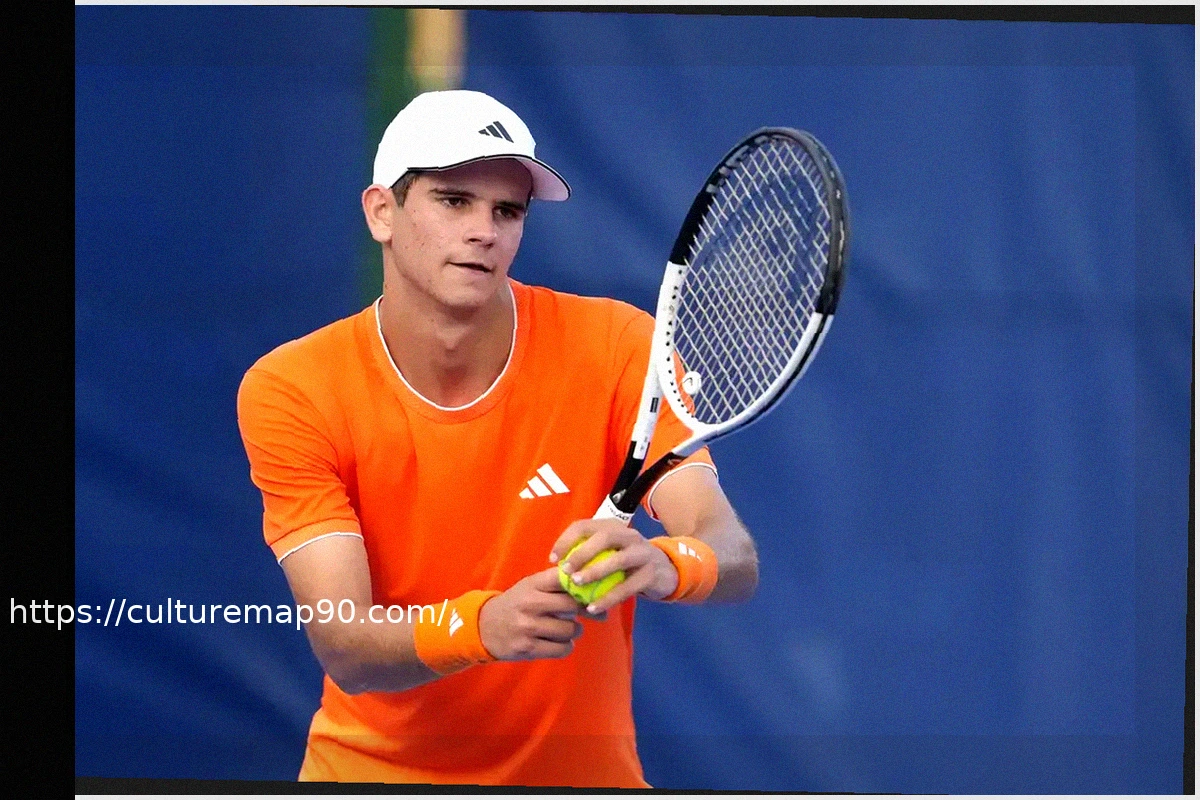
There’s a distinct, quiet confidence that separates truly exceptional athletes from merely good ones. We witnessed it when Carlos Alcaraz silently dominated the baseline at Wimbledon before his name became known to the world. We observed it in a young Rafael Nadal, who battled on clay as if defeat was an unknown concept to him. And now, on Sunday afternoon in Marrakech, under the scorching Moroccan sun at the Grand Prix Hassan II, this feeling emerged once again – in the composure, precision, and almost unnerving resolve with which 19-year-old Rafael Jodar dismantled Marco Trungelliti 6-3, 6-2 to claim his first ATP Tour title. His first. And, almost certainly, not his last.
From World No. 900 to Champion in a Year
Jodar’s story is incredible, and context is key here. Just a year ago, the Madrid native was ranked outside the world’s Top 900. This wasn’t just a minor blip on his journey; it meant that by all conventional measures, he was far from the elite level of professional tennis. Nevertheless, the speed of his ascent has been so dramatic it borders on dizzying. Jodar climbed from outside the Top 900 to a career-high No. 89 in a single year, a trajectory highlighted by three ATP Challenger titles in 2025 that secured his spot at the Next Gen ATP Finals in Jeddah. He turned professional at the end of last season, making his Tour-level debut at the Australian Open in January, and he hasn’t stopped collecting milestones since. Then came Marrakech, and everything accelerated even further.
A Week of Milestones
Jodar arrived in Morocco for the first ATP clay-court tournament of his entire career. Not just his first on the Tour, but his first at any professional level. The red clay of Cour Royale de Tennis was, quite literally, uncharted territory for him. And his response? He lost only one set all week. Following an opening-round victory over Dusan Lajovic, he eliminated fourth seed Tomas Machac with a score of 6-4, 4-6, 6-3 – his third Top 70 victory of the season. This made him only the fourth male player born in 2006 or later to reach the quarterfinals at Tour level. The quarterfinals became the semifinals against Alexandre Muller. The semifinals then led to the final after a stunning demolition of Camilo Ugo Carabelli in just 64 minutes, a scoreline that prompted the ATP’s social media team to simply call him “unplayable.” By the time Sunday’s final arrived, Jodar had become only the second player born in 2006 or later to reach a Tour-level final, following Joao Fonseca.
The Final: Youth Triumphs Decisively
The narrative for the final wrote itself: a 19-year-old prodigy against 36-year-old Marco Trungelliti, the Open Era’s oldest first-time ATP finalist, a veteran experiencing the ride of his life. Tennis adores such symmetries of “firsts,” and this was one for the ages. But Jodar wasn’t interested in drama. He was interested only in winning. After a tense opening game that stretched to ten minutes, Jodar immediately broke Trungelliti’s serve, setting the tone for the entire match. From there, he relied on his dominant first serve and powerful forehand to dismantle the Argentine’s defenses, taking the first set 6-3 with barely a hitch. The second set was even more emphatic. Jodar secured an early break and quickly raced to a 3-0 lead, and when it came time to close out the match, he showed not a hint of nerves, sealing victory with his signature forehand winner – a perfectly fitting conclusion. This is a player who solves problems with his game, trusts his arsenal, and plays the ball, not the occasion. The final scoreline was a statement. Not a stroke of luck. But a true coronation.
Spanish DNA, New-Generation Ambition
It’s impossible not to notice his lineage. Having entered the Top 100 for the first time just days before the tournament, Jodar became the second-youngest player in the top hundred after Joao Fonseca. Comparisons to Nadal and Alcaraz are not mere wishful thinking from the Spanish press; they are the natural result of observing a teenager with elite shot-making, relentless intensity, and an apparent immunity to nerves on clay. What slightly distinguishes Jodar’s story is his unconventional path. Earlier this year, he decided not to return to the University of Virginia for his sophomore season, opting instead to turn professional. He chose the Tour over college tennis, bet on himself, and within months, he had a trophy to show for it. With the Marrakech title secured, Jodar will rise to No. 57 in the ATP rankings next Monday – a position that opens doors to bigger tournaments, better seedings, and a clay-court season that could genuinely turn heads even before Roland Garros. The clay swing stretches ahead of him: Monte Carlo, Barcelona, Madrid, Rome. Surfaces where Spanish players seem to breathe differently, where heavy topspin and relentless baseline aggression are not just effective, but are their natural habitat. Jodar has played only seven professional tournaments. He has already won one. He dropped just one set all week in Marrakech, on a surface he had never played professionally before. His first serve is already a weapon. His forehand is already a weapon. His composure, as it turns out, is also already a weapon. The question for the rest of the clay-court field isn’t whether Rafael Jodar will be a problem this season. The question is: just how significant a problem is he about to become? In Marrakech, he provided the clearest possible answer.